late May, early in the story
The Pedigree Revelation
As he walks home from [Shaston](entity:location-recall-location-b1328d32e8e8), [John Durbeyfield](entity:character-recall-character-john-durbeyfield-763c0d9a878c) meets Parson Tringham, who tells him that he is the surviving male-line descendant of the ancient d’Urberville family. The discovery gives John a title-like fantasy but no land, money, or practical advantage; his ancestors lie in the family vault at [Kingsbere-sub-Greenhill](entity:location-recall-location-kingsbere-sub-greenh-e172dceed7ac).
John embraces the news as proof of greatness, while Tringham recognizes that the family is extinct as a county power. The novel opens by setting inherited status against present poverty, a contrast that will shape the family’s hopes and expose their vulnerability.
the same May evening
The Women’s Club Walk
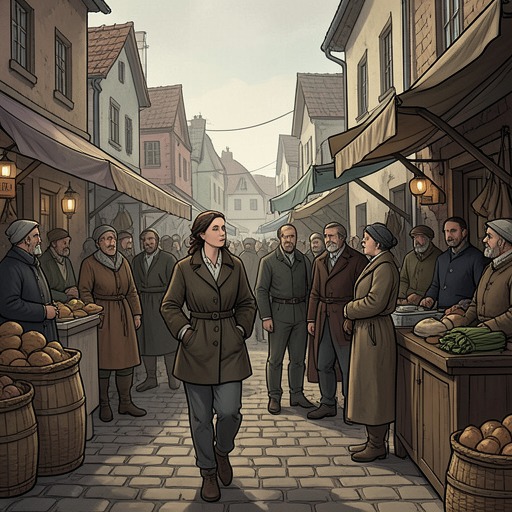
The women of [Marlott](entity:location-recall-location-marlott-473e8f132a42) process in white dresses for their traditional club-walking and dance. [Tess Durbeyfield](entity:character-recall-character-tess-durbeyfield-bf9bc2f03996) joins them, proud and self-conscious when her father rides past in a hired carriage singing about his ancestors.
Three visiting brothers watch the dance. The youngest, [Angel Clare](entity:character-recall-character-angel-clare-8a5f4825a1d0), joins in briefly but chooses another girl as his partner; Tess notices his attention only after he has left. Their missed first encounter establishes the chance and delay that will haunt their later relationship.
that evening
The Family’s New Scheme
At home, [Joan Durbeyfield](entity:character-recall-character-joan-durbeyfield-d28bcfe6c09b) tells Tess that the family has noble ancestry and suggests that a wealthy woman named d’Urberville at [Trantridge](entity:location-recall-location-trantridge-25948dfb0287) may be their relation. Joan has also consulted her fortune-telling book and imagines that Tess might marry a gentleman.
Tess is more concerned with her father’s drinking and failing health than with rank or marriage. But the family’s loss of its horse and livelihood will soon make Joan’s plan seem like a practical route out of poverty.
the next night
Prince’s Fatal Collision
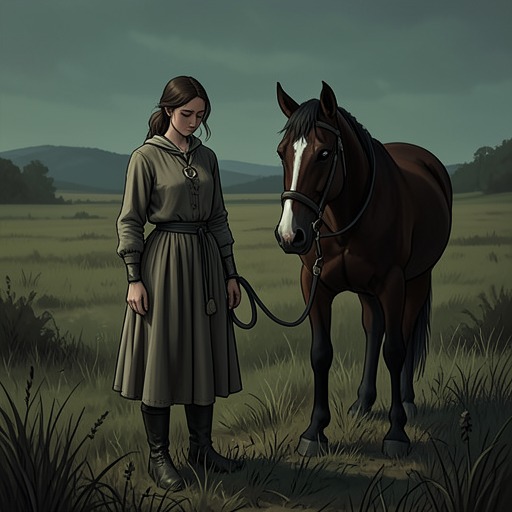
When John is too drunk to take a load of beehives to market, Tess volunteers to drive the wagon, taking her young brother Abraham for company. On the dark road she falls asleep, and the mail-cart strikes the wagon, fatally piercing the family horse, Prince.
Tess blames herself for the accident, while the family loses its means of earning a living. John refuses to sell Prince’s body for a few shillings and buries him in the garden, turning the loss into a small, stubborn act of family dignity.
the following days
Tess Sent to Trantridge
With the family’s livelihood damaged, Joan persuades Tess to visit the wealthy Mrs d’Urberville at [The Slopes](entity:location-recall-location-the-slopes-5472aed6da49), hoping that kinship will bring help. Tess finds a newly built estate rather than the ancestral manor she expected and meets Mrs d’Urberville’s son, Alec d’Urberville, instead of the blind older woman.
Alec treats Tess as a pretty cousin, gives her strawberries and roses, and arranges for her to work with his mother’s poultry. The supposed family connection is false: the wealthy household adopted the d’Urberville name, while Tess is the genuine descendant. She accepts the position chiefly to help her family, despite mistrusting Alec.
early summer
The Coerced Carriage Kiss
On the journey to [Trantridge](entity:location-recall-location-trantridge-25948dfb0287), Alec drives recklessly down steep hills and uses Tess’s fear to demand kisses. She resists, briefly escapes the carriage when her hat blows away, and refuses to ride beside him again, but he continues the journey alongside her.
His conduct turns the apparent protection of a kinsman into a threat. Tess has little power to refuse without losing the employment on which her family now depends, and Alec’s pursuit begins under cover of that dependence.
the first days at Trantridge
Alec’s Pursuit at the Poultry Farm
Tess discovers that Mrs d’Urberville is blind and knows nothing of their supposed kinship. She tends the poultry and is also ordered to whistle to the old woman’s bullfinches; Alec uses the lessons as another excuse to intrude on her work and cultivate familiarity.
Tess remains dependent on the household and tries to keep Alec at a distance. Their unequal positions make even his seemingly playful attention difficult to escape, while the novel steadily exposes the danger concealed by his charm.
September, after several months at Trantridge
The Chaseborough Fair
Tess goes to the market and fair at [Chaseborough](entity:location-recall-location-chaseborough-afb2b308f779) and searches for the [Trantridge](entity:location-recall-location-trantridge-25948dfb0287) workers, who are dancing in a crowded, dusty outbuilding. She waits for them because she does not know the roads and fears walking home alone.
When the dancers turn on her after a quarrel with Car Darch, Alec appears and offers her a ride. Tess accepts the help in the immediate confusion, though his presence does not reassure her; the ride carries her farther into dependence on him.
that night, near one o’clock
The Assault in The Chase
Alec rides Tess away from the road and, taking advantage of fog and her exhaustion, leaves her alone in the woods while he pretends to find their way. When he returns, Tess is asleep among the leaves, and he sexually assaults her.
Hardy presents the episode as a decisive rupture in Tess’s life and condemns the social order that places the burden of shame on her rather than on the man who exploited her. Tess’s experience is not described as a willing romance; it is an abuse of power made possible by isolation, youth, and dependence.
late October, about four months after arriving
Tess Leaves Trantridge
Tess leaves [Trantridge](entity:location-recall-location-trantridge-25948dfb0287) with her possessions and refuses Alec’s offer to take her back or support her. He admits that he wronged her and offers money, but she will not become dependent on him again.
On the road she encounters a religious sign-painter whose texts of damnation intensify her sense of guilt. At home, Joan reproaches her for not securing a marriage, while Tess explains that she was young and unprepared for the danger. Her family’s reaction deepens the social shame she is already struggling to resist.
the weeks after Tess’s return
The Village’s Judgment
Tess’s former schoolmates visit, assuming that Alec’s attention has been a romantic conquest. Their curiosity briefly lifts her spirits, but the next morning she feels isolated and watched; she withdraws from public life and avoids church when she hears people whispering about her.
Hardy distinguishes Tess’s natural feelings from the conventional moral judgment imposed on her. She experiences herself as guilty in a world that has made an arbitrary social rule seem like the law of nature.
August, the following year
Tess Returns to Harvest Work
After months of seclusion, Tess returns to the fields during harvest, bringing her infant with her. The other workers make room for her, and she suckles the child during the midday break while they discreetly look away.
Tess resolves to work and care for her baby rather than live entirely under the judgment of others. Her brief recovery shows that the event has not destroyed her capacity for affection or independence, even as the surrounding gossip continues to define her as a warning to other women.
the child’s final night
The Baby’s Emergency Baptism
When Tess’s infant becomes gravely ill, she asks to summon the parson, but John refuses because he fears that a clergyman will discover the family’s shame. Tess then wakes the younger children and performs a baptism herself, naming the child [Sorrow](entity:character-recall-character-sorrow-2197eea34adb).
The ritual is a desperate act of maternal faith shaped by fear that an unbaptized child will be denied salvation. The parish vicar later assures Tess that her baptism counts spiritually, but refuses a church burial for the child under the rules he feels bound to uphold.
the following morning
Sorrow’s Death and Burial
[Sorrow](entity:character-recall-character-sorrow-2197eea34adb) dies before dawn. Tess buries him by lantern-light in the neglected corner of the churchyard reserved for the unbaptized and others treated as spiritually condemned, then marks the grave with a small cross decorated with flowers.
The loss is both personal and institutional: Tess’s private baptism receives a compassionate verbal recognition from the vicar, but not equal treatment from the church. She is left to mourn a child whose short life has been burdened by the stigma of his birth.
the following spring
The Resolve to Begin Again
After the winter, Tess concludes that she cannot remain in [Marlott](entity:location-recall-location-marlott-473e8f132a42), where every familiar place recalls the failed attempt to claim kin and the scandal surrounding her. She finds an opportunity to work as a milkmaid at [Talbothays Dairy](entity:location-recall-location-talbothays-dairy-9199bd6583cc), far enough away to begin again.
She resolves to be known simply as Tess, not through the d’Urberville ancestry that once seemed a possible advantage. Her departure is a deliberate attempt to escape the past and earn her living independently.
May, two or three years after Tess’s return from Trantridge
Arrival at Talbothays
Tess crosses the highlands and arrives at Tarbosc, a thriving dairy farm in the valley of the Warram (Frum) River. The open, bright scenery and the magnificent sight of the herd of cows renew her spirit; she joins the milkmaids under the care of the farmer
the first weeks at Talbothays
Angel Notices Tess
Angel gradually began to notice Tessa: he first listened to her talk about souls and stars, then observed her intelligence and sensitivity. She admired his musical talent and knowledge, while he saw in her a rare closeness to nature and a deepness shaped by life experiences. Their close relationship developed gradually through
early summer at Talbothays
Tess Learns of the Milkmaids’ Love
Tess accidentally overheard Letty Pridler, [Marian](entity:character-recall-character-marian-1f8d5a5584eb), and Izzy Hute admit that they all loved Angel. She realized that Angel preferred her, yet she worried that accepting his love would take away the chance for other girls to find happiness. The girls' affection was sincere, yet it
a Sunday morning in summer
Angel Carries the Milkmaids
Heavy rain flooded the road leading to the church. Angel waded through the water, carrying [Marian](entity:character-recall-character-marian-1f8d5a5584eb), Izzy, and Retty across the flooded area, then returned to carry Tess in his arms, holding her tightly and bringing her to safety
mid-summer at Talbothays
The First Embrace
The two were milking in a quiet spot on the grass, and Angel could no longer hold back. He knelt beside Tess, embraced her, and confessed his feelings; Tess suddenly joyfully threw herself into his arms, responding to his love
shortly after declaring his love
Angel Consults His Parents
Angelier returned to Emsworth and asked his parents what kind of wife would be suitable for a farmer's partner. He described Tess as beautiful, capable, and well-mannered, though she was the daughter of a farmhouse, not a noblewoman
late summer
Tess Refuses Marriage
Angel proposed to Tess, but she refused, saying she did not deserve him and insisted that for his own good, they should not marry. She loved him, but feared that if he knew the truth, he would regret choosing her. Angel misunderstood her rejection as humility and a lack of confidence in her
autumn, after weeks of courtship
Tess Accepts Angel
As the busy season at the dairy farm draws to a close, Tessa thinks about leaving Tarboches, losing this happy routine. Once, while walking with Angel to the train station, she tried to speak of her origins, then began to tell her past, finally only telling him that she was
the week after the engagement
The Mother’s Advice
Tess wrote a letter to Joan, asking whether she should tell Angela about Alec and the abuse. Joan advised her to stay silent, believing that this was not Tess's fault and that many women would keep such experiences hidden. This advice temporarily eased Tess's anxiety, yet she remained conflicted inside
New Year's Eve
The Wedding at Talbothays
After receiving the certificate, Tess and Angel held a small wedding ceremony, with the farmer Cripple and his wife as the witnesses. Tess devoted herself completely to the marriage, believing that no matter what she told Angel in the future, his love for her would remain unchanged. In the afternoon, a ro
their first evening at Wellbridge
The Wedding Jewels
At Wilburch's old house, Angel gave the godmother's jewelry, left for his future wife, to Tess. Tess put on the jewelry, and Angel was amazed at how beautiful she looked with it, although he said he preferred her in plain country clothes
their wedding night
Angel’s Confession
Tess had not yet confessed, when Angel told her that he had had a two-day sexual relationship with a woman in London. He said he regretted that experience and had not repeated it, and then asked Tess for forgiveness. Tess forgave him immediately and regarded his confession as proof that he could
the night of the confession
Angel Rejects Tess
Tess could not reconcile her idealized self with the past she confessed. Tess reminded him that she had forgiven his misdeeds; he, however, said that the woman he had loved was no longer the same, and could not accept her as his wife in the usual sense. Tess pleaded with
the first night after the confession
The Failed Suicide Attempt
While walking at night, Tessa told Angel that she had once considered jumping into the water to avoid burdening him with the weight of the marriage. She had also considered hanging herself, but she never actually did it. Angel was deeply shaken by this, but he did not recover their close relationship
the second night at Wellbridge
Angel’s Sleepwalking Journey
Angel wandered into Tess's room, claiming she was dead, wrapped her in the bedsheet, and carried her outside. He never woke up, holding her across the river, and placed her into an empty stone coffin in the ruins of the convent. Tess understood that he was repeating the earlier scene when
three days after the confession
The Separation
Angel said he could not live with Tessa partly because he was worried about the consequences their future children might face, and partly because his imagination of Tessa had completely collapsed. Tessa agreed that they should part and said she would go home. Angel gave her some money and told her not to come
early January
Tess Returns to Marlott
On the way home, Tess learns that her family has celebrated her wedding as a triumph and that John has been boasting of their noble connection. She reaches home alone and tells Joan that Angel has left after hearing her history.
Joan calls Tess foolish for confessing, while John worries most about the family’s public humiliation. Their response convinces Tess that she cannot remain at home without becoming a burden and a subject of gossip.
a few days after New Year
Tess Leaves Home Again
Angel sends a brief note saying he has gone north to inspect a farm. Tess uses it to explain her departure to her family, concealing the true extent of the estrangement, and gives Joan half the money Angel left her.
She then supports herself through irregular dairy and harvest work, refusing to live on Angel’s allowance when she can avoid it. Her pride and her wish to protect his reputation deepen her isolation and leave her with little security.
a few weeks after the separation
Angel Departs for Brazil
After returning to [Emminster](entity:location-recall-location-emminster-481a99e4d073), Angel decides to seek a farming opportunity in Brazil. His parents do not know the true reason for the separation and believe Tess is temporarily with her relatives; Angel leaves without arranging direct contact between her and his family.
At [Wellbridge](entity:location-recall-location-wellbridge-6c0da4243c8f), he revisits the room where he and Tess spent their first days as newlyweds and regrets his harshness, but still departs. His decision leaves Tess to endure the consequences alone, even as his own illness and experiences abroad begin to alter his judgment.
the following autumn and winter
Tess’s Struggle at Flintcomb-Ash
After her savings dwindle, Tess seeks work at [Flintcomb-Ash Farm](entity:location-recall-location-flintcomb-ash-farm-93eb1cc20f40). She labors in harsh weather at swede hacking and trimming, living in poor conditions and declining to ask Angel’s family for more money.
[Marian](entity:character-recall-character-marian-1f8d5a5584eb) joins her and later [Izz Huett](entity:character-recall-character-izz-huett-b9a3d54f546e) arrives. The three women recall their time at [Talbothays](entity:location-recall-location-talbothays-b24f2e111f8b), but Tess’s work and poverty show how little protection marriage has given her. She continues to believe that Angel may return, while keeping her situation hidden from both families.
winter, about a year after the wedding
Tess’s Failed Visit to Emminster
Tess walks fifteen miles to the Clare family’s home, hoping to ask after Angel and enlist his parents’ sympathy. She arrives while the family is at church, then overhears Angel’s brothers discussing his marriage and sees them recover her discarded walking boots as supposed evidence of a beggar’s deceit.
Ashamed and discouraged, Tess turns away without meeting the parents, who might have treated her kindly. The failed visit reinforces her belief that she has no rightful claim on the family and leaves her unable to ask for help.
winter, during Tess’s work at Flintcomb-Ash
Alec’s Conversion
Tess hears a preacher in a barn and recognizes Alec d’Urberville, now dressed as a religious convert. He says that the words of the Reverend [James Clare](entity:character-recall-character-james-clare-a05c8d6a6e6b) helped bring about his conversion after Alec had insulted him during an earlier encounter.
The transformation unsettles Tess: the man who harmed her now speaks as a spiritual authority. When Alec follows her along the road, she challenges the sincerity of his new faith and tells him about their child, but he leaves with a promise that their paths will cross again.
later that winter
Alec’s Marriage Proposal
Alec visits Tess at [Flintcomb-Ash](entity:location-recall-location-flintcomb-ash-a7365f3cf651) and asks her to marry him, presenting a marriage licence and calling it a chance to make reparation for the past. He says he intends to sell his estate and devote himself to missionary work in Africa.
Tess refuses because she does not love him and is already married to Angel. Alec tears up the licence, but learns that Angel lives far away and has not returned. His remorse and concern begin to give way to renewed desire and resentment.
the following February
Alec Abandons His Ministry
Alec returns to Tess and admits that he has abandoned his preaching because he cannot stop thinking about her. He blames her beauty for drawing him away from his religious life and again presses his attention upon her.
Tess rejects the accusation and insists that she has done nothing to cause his choices. Alec’s conversion proves temporary: once his desire revives, he discards the beliefs he had recently proclaimed and renews his pursuit of her.
the same winter
The Warning from the Dairy
Alec comes to Tess while she is working at [Flintcomb-Ash](entity:location-recall-location-flintcomb-ash-a7365f3cf651)’s threshing machine. He says that he has given up preaching and offers to support her and her family; Tess refuses his money and strikes him across the mouth with her heavy glove when he tries to claim that she belongs to him.
Alec warns that he will return for an answer, and Tess recognizes the threat behind his renewed tenderness. Afterward she writes a desperate appeal to Angel, asking him to come or let her join him before she is trapped again.
March, as her mother falls ill
Tess Returns to Marlott
Tess’s younger sister, ’Liza-Lu, brings word that Joan is gravely ill and John’s health is failing. Tess leaves [Flintcomb-Ash](entity:location-recall-location-flintcomb-ash-a7365f3cf651) at once and walks through the night to [Marlott](entity:location-recall-location-marlott-473e8f132a42) to care for her mother and siblings.
John dies soon after Tess’s return. His death ends the family’s right to remain in their cottage, while Tess’s presence and the family’s precarious circumstances make their displacement immediate.
Old Lady-Day, early April
The Family Is Evicted
As the agricultural hiring year turns over, the Durbeyfields are required to leave their home in [Marlott](entity:location-recall-location-marlott-473e8f132a42). The village has lost many of its independent tradespeople and cottages, and the family’s tenancy is not renewed.
Tess believes her return helped draw attention to the household and its disfavored reputation. Her family’s displacement makes plain that ancestral claims offer no defense against the economic power of landlords and changing rural labor arrangements.
the eve of the move from Marlott
Tess Refuses Alec’s Shelter
Alec finds Tess at the family cottage and offers his empty poultry house at [Trantridge](entity:location-recall-location-trantridge-25948dfb0287) as shelter, promising schooling for the children and support for Joan. Tess refuses because she cannot trust his motives or rely on his promises.
When Alec taunts her that Angel will never return, Tess writes a bitter letter to her husband accusing him of treating her cruelly. She then tries to prepare her younger siblings for leaving the only home they have known.
Old Lady-Day, early April
No Shelter at Kingsbere
The family’s hired wagon carries them to [Kingsbere](entity:location-recall-location-kingsbere-2712e27b4a99), where Joan expects to find rooms near the ancestral tombs. On arrival they learn that the lodging they had sought has already been let, and the exhausted family has nowhere to go.
They unload their furniture beside the church and make a makeshift shelter beneath the d’Urberville aisle. The descendants of the family whose old grandeur Joan invoked are left exposed among the ruins of its former status.
about a month later
Marian and Izz Warn Angel
[Marian](entity:character-recall-character-marian-1f8d5a5584eb) and Izz learn that Angel is expected to return from Brazil. Remembering how much Tess loves him and fearing Alec’s influence, they write to Angel urging him to find and protect his wife.
Their intervention breaks Tess’s silence at a crucial moment. The letter reaches Angel after his own changed experiences have already begun to soften his judgment, and it helps prompt him to seek her out.
spring, after nearly a year abroad
Angel Returns from Brazil
Angel returns to [Emminster](entity:location-recall-location-emminster-481a99e4d073) weakened by illness and altered by his experiences among migrants and laborers in Brazil. He has come to question the moral judgments that led him to reject Tess and now sees that her intentions matter more than the event he once treated as definitive.
After receiving Tess’s letters and [Marian](entity:character-recall-character-marian-1f8d5a5584eb) and Izz’s warning, he sets out to find her. He first searches at [Flintcomb-Ash](entity:location-recall-location-flintcomb-ash-a7365f3cf651) and [Marlott](entity:location-recall-location-marlott-473e8f132a42), then learns from Joan that Tess is in [Sandbourne](entity:location-recall-location-sandbourne-4443a8cf4e59).
a spring morning
The Final Reunion at Sandbourne
Angel finds Tess lodging at [The Herons](entity:location-recall-location-the-herons-2b572d415a2c), where she is living as Mrs d’Urberville. She appears in fashionable clothes, and tells him that Alec has persuaded her he would never return; after her family lost its home, she gave in to Alec’s support and influence.
Angel realizes that he has arrived too late. Tess says she still loves him but asks him to leave, because Alec has won her back. Their reunion exposes the cost of Angel’s long absence and Tess’s desperate need to secure her family’s survival.
shortly after the reunion
Tess Kills Alec
After Angel leaves, Tess returns to the room she shares with Alec and confronts him for persuading her that Angel would never come back. She says that Alec’s pressure and taunts about her family helped make her surrender to him.
The landlady later discovers Alec dead in bed, stabbed with a carving knife. Tess has killed the man who repeatedly exploited her, but the act makes her a fugitive and turns her hope of recovering her marriage into a new crisis.
the same day
Tess and Angel Flee
Angel walks away from [Sandbourne](entity:location-recall-location-sandbourne-4443a8cf4e59) in shock, but Tess runs after him and tells him that she has killed Alec. She begs him to believe that she did it because Alec had come between them and had tormented her about their separation.
Angel believes her and embraces her, promising not to desert her. Together they leave the town and travel inland, avoiding roads and settlements as they try to remain undiscovered. Their brief happiness is restored under the shadow of the crime and the law pursuing Tess.
the first five days of their flight
The Forest Refuge
Tess and Angel take refuge in an empty mansion in the [New Forest](entity:location-recall-location-new-forest-daa8d8d812b0), slipping inside through an open window. They hide in darkness while a caretaker closes the house, then remain secluded for several days, eating what Angel can obtain and avoiding the outside world.
For Tess, the shelter becomes a temporary world in which they can live as lovers without confronting the past or the law. Angel knows the refuge cannot last, but neither is ready to relinquish the fragile happiness they have recovered.
after five days in the mansion
Flight Through Melchester
When the caretaker’s return seems likely, Tess and Angel leave the empty house and continue north. They pass through [Melchester](entity:location-recall-location-melchester-4ce13cb674aa) at night, keeping to quiet paths and avoiding notice.
They have no practical plan for escaping the country and move more by instinct than strategy. Tess is exhausted but insists on continuing with Angel, whose tenderness now matters more to her than the uncertainty of their future.
the final night of the flight
The Night at Stonehenge
Near dawn, Tess and Angel stumble into [Stonehenge](entity:location-recall-location-stonehenge-4435184df0e0). Tess lies down on a warm stone, calling the ancient monument a home suited to her supposed heathen nature. She asks Angel to care for ’Liza-Lu if she dies and wonders whether they will meet again after death.
Police officers surround the stones as Tess sleeps. When she wakes and understands that they have come for her, she accepts her arrest calmly, saying that their brief happiness could not have lasted and that she has had enough.
the next morning
The Black Flag
Angel and ’Liza-Lu leave the prison at [Wintoncester](entity:location-recall-location-wintoncester-9bbd176fd202) and climb the hill beyond the city. They wait in silence, watching the prison tower where Tess is being held.
A black flag rises above the building, signaling that Tess has been executed. Angel and ’Liza-Lu bow toward the ground, then join hands and walk on. The novel ends with Tess’s death and the bitter irony of a justice that punishes the woman whose life has been shaped by exploitation, social stigma, and chance.